

Meshy 7: AI converts images to more accurate 3D models, good news for 3D printing enthusiasts making figures
Meshy has just released Meshy 7 — a new version of the AI image-to-3D tool, focusing on solving the problem of "beautiful models but not matching the original image". This is a notable upgrade for those who frequently use AI to create STL/OBJ files from photos or concept art before sending to 3D printers.
Meshy 7 — next-generation AI model that converts images into 3D structures. Source: Meshy.
The problem that Meshy 7 solves
If you have ever used image-to-3D AI tools to create print files quickly — for example, photographing a toy and turning it into an STL file, or using character concept art to print figures — you may have encountered this situation: the 3D model looks "clean", without mesh breakage, but does not actually resemble the original image. Hands are placed in wrong positions, body proportions are distorted, and engravings on the surface disappear.
Meshy calls this the 'geometry alignment' issue — the geometric alignment between the input image and the generated 3D model. According to Meshy, severe mesh errors (missing limbs, meaningless shapes) are now rare in leading AI models, so the key issue is no longer 'whether a valid model can be created' but 'whether the model is actually what the user wants'.
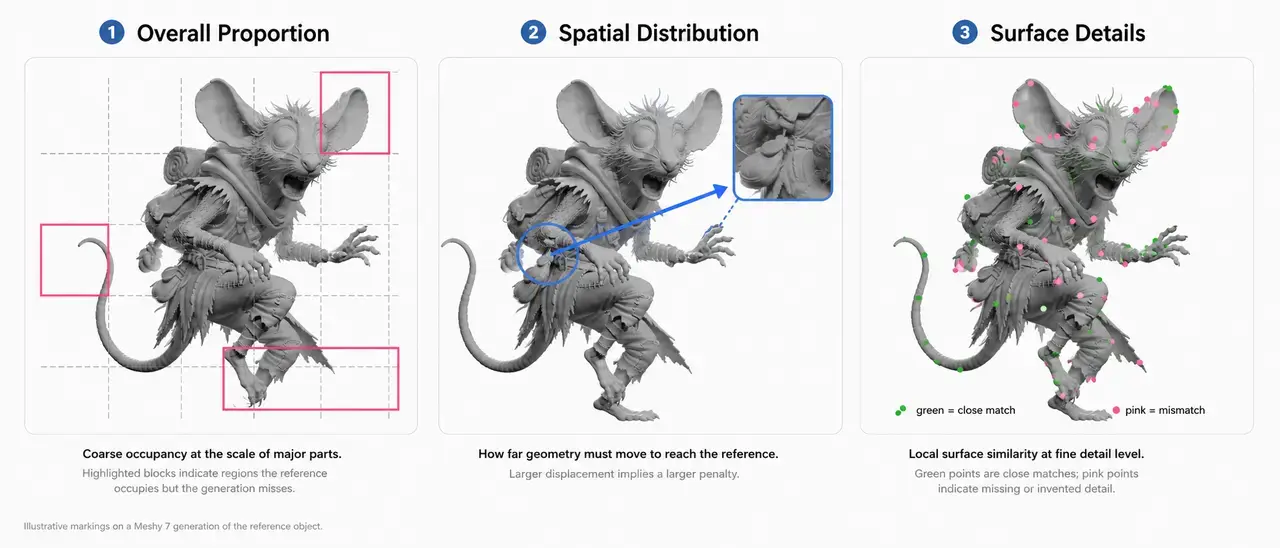
Three metrics measuring geometric alignment: overall proportion, spatial distribution, surface details — illustrated on a model created by Meshy 7. Source: Meshy.
What Meshy 7 improves
According to the official announcement from Meshy (12/8/2026), version 7 has improvements in three areas:
Better input image reading: the image encoder is upgraded to read details at different scales and accept higher-resolution images, helping to preserve small shape details from the original image.
Training data is more accurately matched: each training data sample is reconstructed to precisely correspond to the target geometry, removing the influence of style, lighting, and background.
Incorporate geometric fit into the training evaluation loop: throughout development, Meshy uses this metric as a direct evaluation signal, instead of relying solely on subjective judgment or vision-language models.
Benchmark results (with only one input image)
Criteria | Meshy 7 | Meshy 6 Lite | Tripo 3.1 | Hunyuan3D 3.1 | Rodin 2.5 | Hi3D 2.1 |
|---|---|---|---|---|---|---|
Overall rate | 81.0% | 78.2% | 79.0% | 76.7% | 72.0% | 79.1% |
Spatial distribution | 79.7% | 75.2% | 78.4% | 73.7% | 71.4% | 76.5% |
Surface details | 59,8% | 52,7% | 51,7% | 54,5% | 49,0% | 55.2% |
FACT: Data published by Meshy on its official blog, measured using input images at the "top-quarter" angle (top oblique), compared to four other competing AI models. A score of 100% represents a reference model compared to itself.
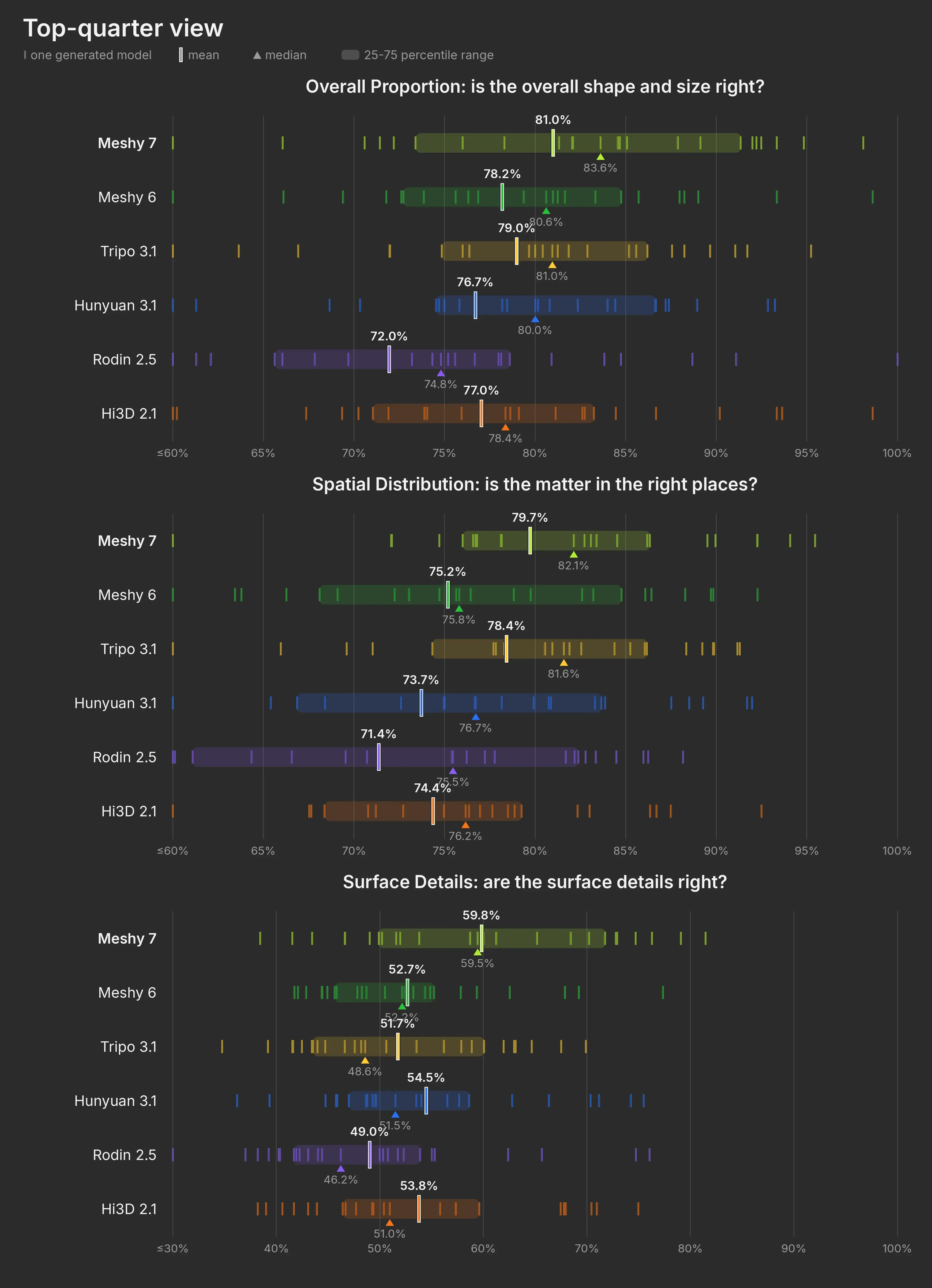
Benchmark score distribution under single-image top-quarter oblique conditions. Source: Meshy.
Meshy 7 leads in all three criteria with just one input image, with the largest gap in "surface detail"—the most challenging area, where no model has exceeded 60%. When four images (front, back, left, right) are provided, the gap between top models narrows, and some competitors, like Tripo 3.1, even surpass Meshy 7 in certain metrics.
Strengths and practical limitations
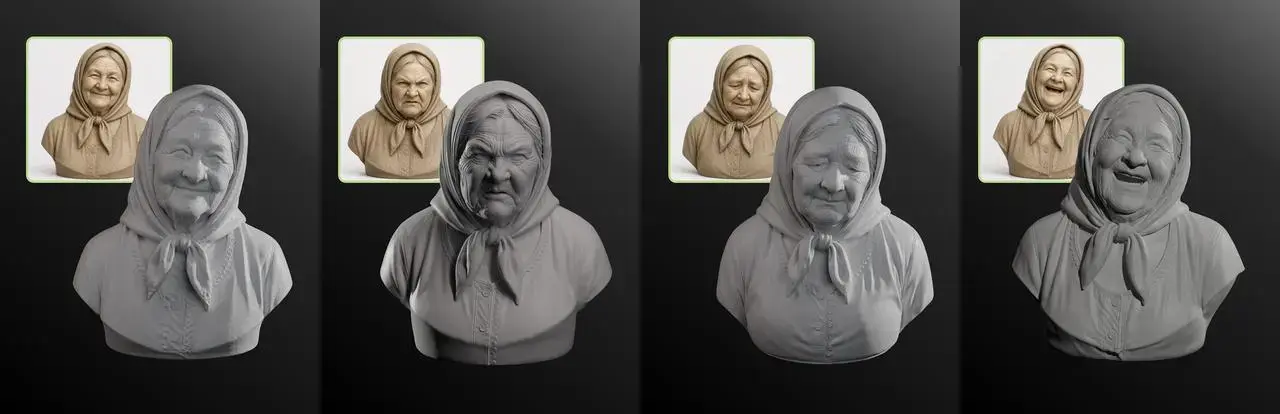
Four bust models generated by Meshy 7, each with the original reference image — facial expressions are kept quite close. Source: Meshy.
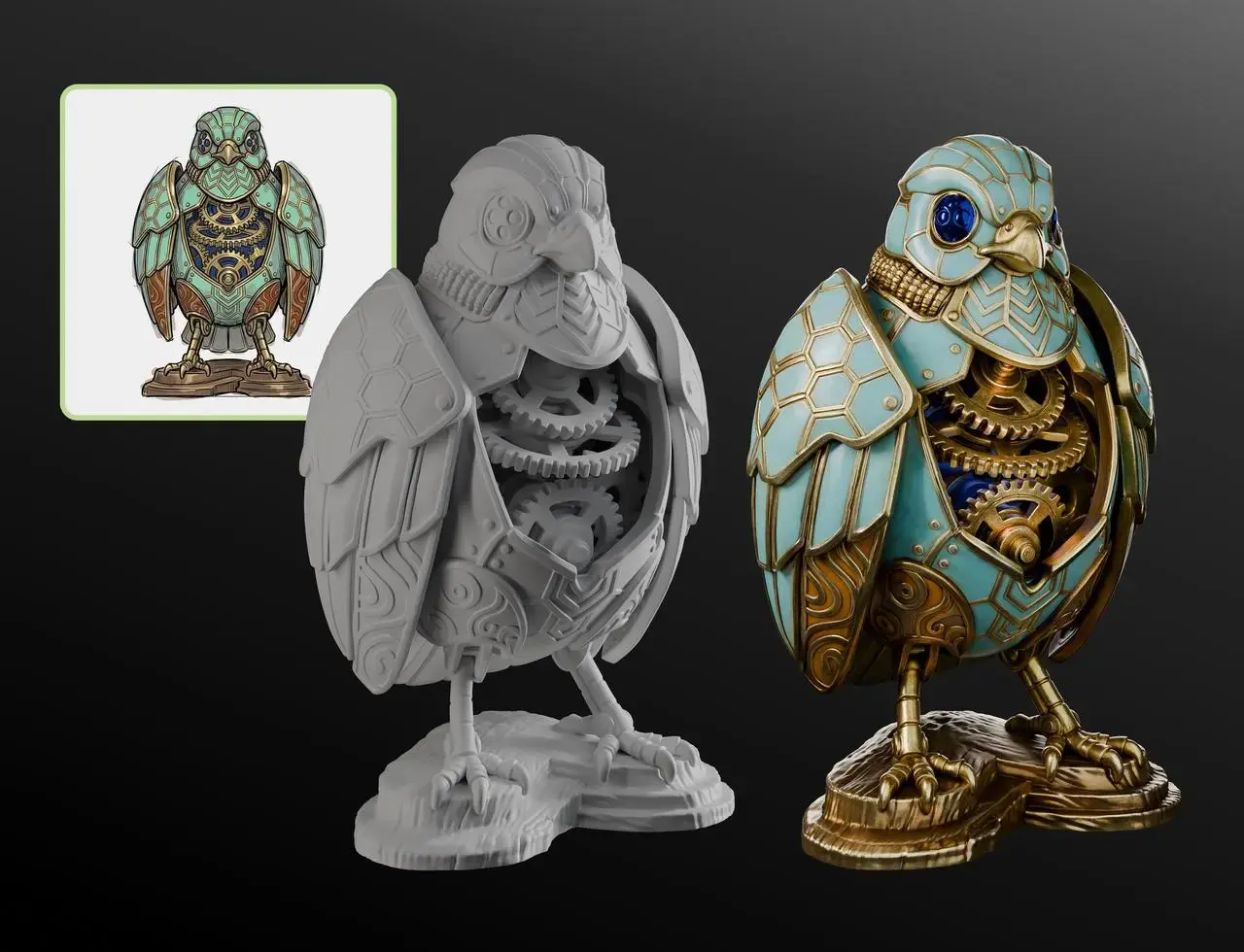
Concept art (left), geometry generated and textured result (right) — complex mechanical parts are arranged in correct positions. Source: Meshy.
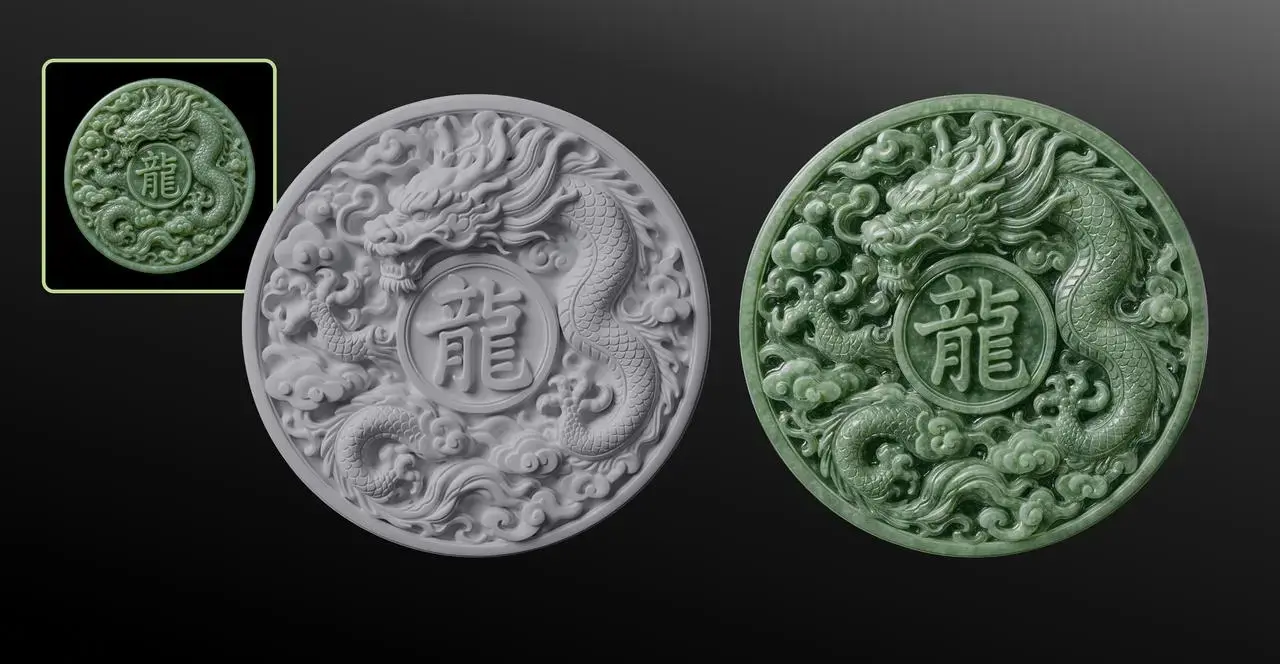
Jade coin with relief dragon — challenging test of dense, thin surface details. Source: Meshy.
From the examples Meshy published:
Strengths: preserving facial expressions in busts, correctly positioning complex mechanical parts (e.g., camera model with multiple layers of blades, gears), and maintaining dense relief patterns (e.g., jade coin face with carved dragon).
Remaining limitations: loose hair and thin strands are still merged by AI into thick clumps instead of being separated into individual strands; precisely repeating patterns (such as identical rows of windows on multi-story buildings) still fall out of rhythm and appear uneven.
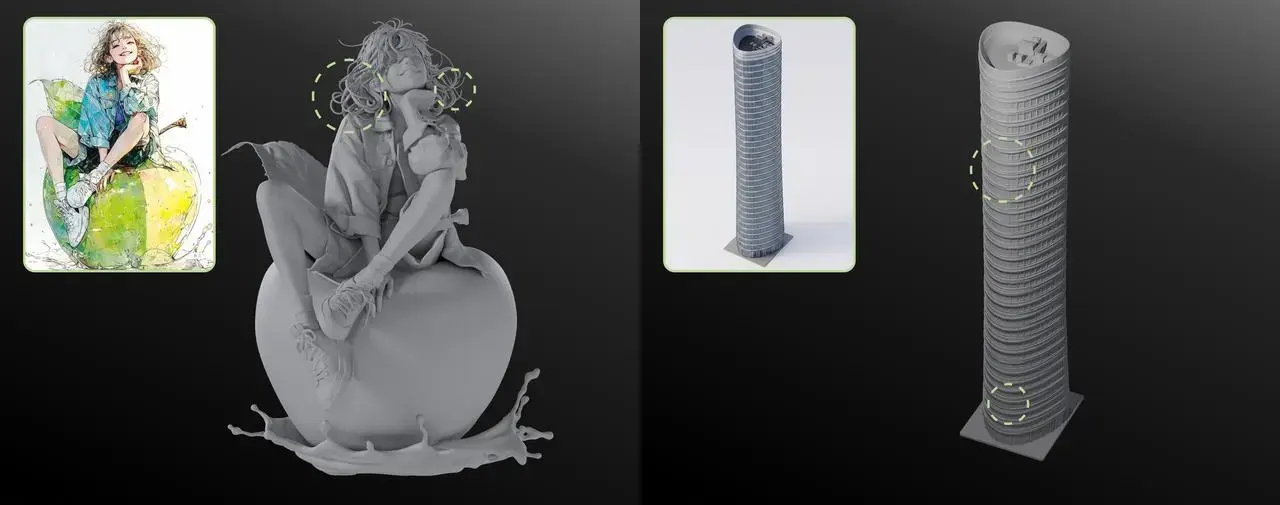
Two common limitations: thin hair is merged into thick clumps (left), repeating patterns on buildings fall out of rhythm (right). Source: Meshy.
These are two points that 3D printing users should keep in mind if they plan to use Meshy 7 to create models with detailed hair or regular repeating patterns — manual editing in CAD or slicer software before printing may still be required.
Usage and fees
Meshy 7 officially operates from 8/10/2026, open to all users who have registered a Meshy account.
Meshy 7's "Ultra Mode" currently only supports single-view input images; multi-view image support will come later.
Downloading the generated model file requires a Pro plan or higher — free accounts can create models to view but cannot download them.
Meshy offers an integrated plugin for popular 3D printing software such as Bambu Studio, Creality Print, OrcaSlicer, Cura, Lychee Slicer.
Why is this important for 3D printing users?
REPORT/OPINION: For figure makers, decorative models, or custom accessories from reference images, an AI model that "more closely resembles the original image" means less manual mesh fixing before printing — saving post-processing time in Blender or mesh editing software. However, note that this is benchmark data released by Meshy itself and measured on a self-selected dataset; users should try it on their own real images before concluding whether the improvement matches the advertising.
If you are a 3D printing enthusiast, you cannot miss this AI.
References
Meshy (official blog) — https://www.meshy.ai/blog/meshy-7-image-to-3d-geometry-alignment — All benchmark figures, technical descriptions, release date, service package policies, and illustrative images.
PR Newswire (Meshy press release) — link — Confirms launch date and benchmark figures.
3D Printing Industry — link — Comparison context with the previous Meshy 6 version.
Fabbaloo — link — Analytical perspective from the 3D printing magazine on the issue "AI slop" in 3D models.
